Headliner of BHD Zac Crippen Christians need to reclaim the term “content creator”

I can play to the algorithm in a way that does not compromise my integrity, and that's what I should do, says the co-leader of the most popular prayer app.
Vypočuť
Headliner of BHD Zac Crippen / Christians need to reclaim the term “content creator”
Najčítanejšie
Deň
Týždeň
Kánonické právo, schizma a lefebvristi Biskupská vysviacka bez pápežského mandátu nie je len neposlušnosť, ale zásah do samotnej štruktúry cirkvi
Slovo kňaza Ísť zlatou strednou cestou
Reakcie na exkomunikácie Lefebvristi hovoria o trestajúcom otcovi, konzervatívny kardinál ich prirovnal k schizmatikom z čias sv. Augustína
Novokňazi 2026 Vysviacka bude v každej diecéze, po 40 rokoch však nemá novokňaza Prešovská archieparchia. Pozrite sa, koho vysvätia (+ foto)
Formátor v seminári Marek Kunder Ak si kňaz neudrží správne motivácie, príde znechutenie, ktoré rieši cez deštruktívne náhrady
Desať rokov Amoris laetitia Lev XIV. zvoláva do Ríma lídrov miestnych cirkví. Chce diskutovať o Františkovom dokumente, ktorý vyvolal polemiku
Kánonické právo, schizma a lefebvristi Biskupská vysviacka bez pápežského mandátu nie je len neposlušnosť, ale zásah do samotnej štruktúry cirkvi
Slovo kňaza Ísť zlatou strednou cestou
Reakcie na exkomunikácie Lefebvristi hovoria o trestajúcom otcovi, konzervatívny kardinál ich prirovnal k schizmatikom z čias sv. Augustína
Formátor v seminári Marek Kunder Ak si kňaz neudrží správne motivácie, príde znechutenie, ktoré rieši cez deštruktívne náhrady
Novokňazi 2026 Vysviacka bude v každej diecéze, po 40 rokoch však nemá novokňaza Prešovská archieparchia. Pozrite sa, koho vysvätia (+ foto)
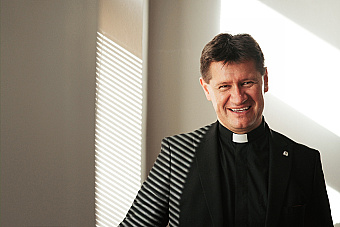
Zac Crippen is a member of the leadership team of Catholic app Hallow, world’s most popular prayer and meditation app. He is an alumnus of Oxford University and has served in the US Air Force for ten years. Crippen is a practising Byzantine Catholic. He lives with his wife and five children in South Bend, Illinois, USA.
We talked about the app itself and the challenges that Catholics who are active online face nowadays, especially concerning generative AI. We also talked about the problems of the European market, the resurgence of interest in religion among young generations and Crippen’s love for Byzantine rite.
The interview was conducted on the occasion of Bratislava Hanus Days 2025, at which he was one of the main speakers.
Tento článok je anglickou verziou rozhovoru, ktorý si môžete v slovenčine prečítať na tomto odkaze.
Hallow is a very popular application for Catholic prayers. However, it is not generally very well-known in Slovakia. Therefore, I would like you to give some kind of like elevator pitch to our readers about what the what Hallow is and how can they benefit from it.
I’m a member of the leadership team of Hallow, but I’m not one of the co-founders. I’ve been at Hallow for about four years, but the app itself is six years old now.
It was founded in 2018 by three friends who had gone to the University of Notre Dame in the United States and had recovered their Catholic faith. And then they thought that they should help the rest of the world also find the Catholic faith or recover their faith.
And so they started Hallow. Hallow is a prayer and meditation app, and it is actually the leading prayer and meditation app in the world. And very importantly for us, it is completely Catholic. Everything on the app is in accordance with Catholic teaching.
We’ve carefully designed Hallow to help introduce people to a life of prayer, and to be an appropriate tool for people who have been praying every day of their life, but also for people who have never prayed once.
It exists to introduce people to 2000 years of Christian tradition of contemplative prayer and meditation in a way that is easily accessible and helpful for people in a modern life that's beset by distractions and other challenges.
These distractions are not exclusively Catholic problem, but a problem for almost every user of social media and modern technology. Do you have any feedback from non-Catholics about how did your app help them with it?
Yes—in fact, about 30 to 40 % of our users are non-Catholic by our estimates. That number is a combination of non-Christians and Protestant Christians. So, the app clearly has enjoyed a lot of interest from people who are not Catholic.
We’ve designed the app to be authentically Catholic and nothing on the app will ever contradict church teaching. That’s our firm conviction. But I would say the interest and the feedback from non-Catholics has been overwhelmingly positive.
Of course, there are always going to be people who download the app and see that it has the Rosary, and then mistakenly think: “This is not for me because this is idolatry”. But on the other hand, we’ve heard from people who have experienced the richness of Catholic prayer for the first time in their life and have come into the Catholic Church through encountering that. Those are some of my favourite stories.
You are the person responsible for the expansion of Hallow to international markets. How does that work? Do you tailor the content for specific markets?
Yes, we absolutely do. People are different. We’re all human beings made uniquely in the image of God, and each of us bears his fingerprints in a certain unique way. Our cultures and national identities and languages also bear God’s fingerprints.
As we expand into each market, it is very important for us to do so with respect and deference to the existing culture of that market and to the ways in which the Church has expressed itself there. We do our best to find people who are already operating fruitful apostolates in those countries, and we try to work with them. We say: “We are new to this culture. But we know that you have a flourishing ministry. How can we amplify what you are doing?”
And when we expand to those countries or languages, we also hire people from those countries so that we have people on the ground who know and understand the experiences of Catholics and non-Catholics in each place. Then, we can particularly design content to meet the needs of the people in each particularity.
.jpg)
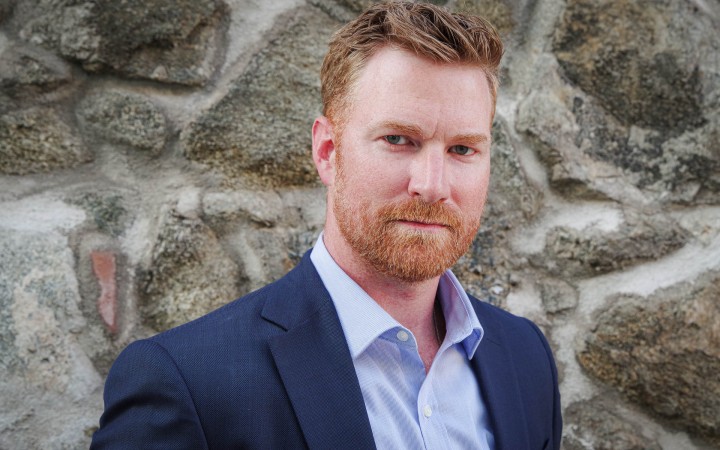
Zac Crippen. Photo: Postoj/Jakub Lipták
So, when you will expand to Slovakia somewhere in the future, can we expect some kind of collaboration between Hallow and our Byzantine Catholic priests or something like that?
Yes, that’s the plan. We have a strong desire to work closely with priests and nuns when we go into any new market, because we want to be servants of the Church as well, we do not supersede the Church.
So, in a place like Slovakia that has a rich tradition not just of Latin rite Catholicism, but also of Byzantine rite Catholicism, it will be very important for us to have Latin and Byzantine priests in the app who can help guide pilgrims of each tradition into a relationship with God.
Several months ago, your CEO wrote on X about how you struggle with the over-regulation of the European market. What specifically was the problem? And how is it going with solving it right now?
We’re still trying to get to the bottom of exactly why this happened. Several months ago, Meta instituted a blanket set of rules against all religious, finance, and fitness apps that severely limited what types of advertising these apps could do on Meta's platforms. Other app types were not affected at all.
And because we’re considered a religious app, Meta applied the same restriction to us. So that effectively changes our ability to use Meta’s tools for customer acquisition and limits our ability to acquire new customers in Europe. We’re working to figure it out. We’re working to generate other strategies and approaches, but it has certainly been a challenge.
Maybe because finances and lifestyle and religious affiliation is sensitive data, so under the Digital Services Act of the European Union, that could be a problem, right?
That is probably what happened, although as far as we can tell, Meta did not do this in response to any specific legislation. Interestingly, Meta also made this rule without any respect to the privacy policies of those apps themselves. So, this is not actually a decision about our data practices.
At Hallow, we have very strict data practices and very strict privacy policies in place to protect our users’ data, and we do not harvest or sell our users data. But Meta made this restriction without respect to any of our privacy or data policies. They applied it to us simply because we're a religious app.

As you demonstrated yesterday at your talk at Bratislava Hanus Days, you are not only a businessman, but also somewhat of a thinker in relation to the app and its mission. Therefore, I would like to ask you a few philosophical questions as well. The first one is about the term “content creator” itself. Several weeks ago, Catholic apologist Trent Horn released a video in which he called for the abolition of this term, because he finds it dehumanizing. He claims that people who create Catholic content online should consider themselves to be artists, not some kind of dystopian content-pumping machines. I would like your take on that.
I like Trent a lot and I agree with him in substance. I disagree with him on the specifics of rejecting the term “content creator.” What I talked about last night was that we need to reclaim the title of content creator because it has become something that's awful. It’s sold out to algorithmic relativism and click farming and rage baiting. And so, when people now say: “I'm a content creator”, we all have this vision in our heads: “OK, you make cheap YouTube videos for clicks.”
But that's not what being a creator should be. We should reclaim the word creator because God is the Creator. We should be proud of that. We are made in the image of God, we are each called to be creators, but that does not mean making this kind of YouTube slop that that Trent and I have criticized.
In addition to that, there's this other problem that Catholics who try to enter the realm of social media often encounter. How do you find balance between, on one hand, being familiar with the trends, knowing how to use social media effectively, how to attract attention and so on, and on the other hand, not considering the popularity and success on social media to be the end goal? According to advice of St. Josemaria Escriva, we should be in this world, but not of this world. What helps you as someone who could be considered a Catholic content creator in finding this balance?
If I play to the algorithm in a way that compromises my artistic integrity, then that is bad. But I can also play to the algorithm in a way that does not compromise my artistic integrity, and that's what I should do.
I can give you an example of that. You can imagine making a thoughtful podcast. And you know that the way to optimize its audience size is to have a 30-minute podcast episode rather than a longer episode. But let’s say you’re addressing a topic that you think cannot be addressed adequately in 30 minutes--that you need at least an hour to do this. You can do that; you can make an hour-long podcast. But another alternative would be to make your hour-long podcast divided up into two parts.
So, you’re not compromising the integrity of the product, you’re not cheapening it, you’re not omitting the things that you want to say, but you’re breaking it up into a two-part podcast because you know that that's more likely to appear in people’s feeds. That is not an artistic compromise. That is a pragmatic prudential judgment based on what you know about the algorithm and how the algorithm services content to people.
On the other hand, what else trends? Well, people getting angry, right? And so, I could record a conversation in which I get mad at a person with whom I disagree, and we would start to argue and yell at each other. And that would be an example of a compromise that is driven by the algorithm that we should not pursue.
.jpg)
Zac Crippen. Photo: Postoj/Jakub Lipták
Let’s move to another big topic, and that’s AI, specifically generative AI and large language models. There’s been a controversy with one of the biggest Catholic media companies in the US where they used some kind of AI avatar and they called him Father Justin, implying that he’s a priest. I think it’s safe to say that it caused an outrage on Catholic social media. Later, they apologized and changed it. It’s kind of sensitive to implement AI into your product, especially if it’s of religious nature. I wanted to ask you, how are you willing to use it and maybe how do you implement it into your product without, as you said, compromising your integrity?
We have one implementation of AI in the product right now that is called Magisterium AI. This is not a product that’s been developed by Hallow, but it’s been adapted by Hallow. It was actually developed by a team of technologists who live in Rome and who have worked closely with the Vatican on policy issues around AI. We present it in the app simply as a search tool.
The example that you just brought up of this Catholic company making a priest avatar chatbot is problematic for a bunch of reasons, but foremost of those is that they are presenting the AI as a person: “This is Father Justin, and you can chat with Father Justin about your problems.”
The technology we use is set up strictly as a search and research tool. Even the way that we present it in the app, the way that we describe it in the in the documentation, the way that the user interface is presented – it is all as a search tool.
And this is, I think, is actually a great use of large language models because this is essentially what they are. Whenever large language models are imitating a person and we’re chatting with ChatGPT as if we would chat with a friend, all that it is doing is putting a fancy wrapper around what is essentially a very advanced search engine. That's what a large language model is.
So Magisterium AI isn’t impersonating a priest. It’s helping with reseach. And this is actually a good use of this technology. You might ask, for example, “what did Pope Leo XIII think of modernism.” You could type that into Google, and you'll see some search results that you can click through and read. You can also type that query into Magisterium AI, and it will very quickly search every Vatican document, every papal encyclical ever published and tell you exactly what, according to those documents, Pope Leo XIII thought of modernism.
So that’s a good implementation of AI that we're proud of and that we stand behind, and our users have really enjoyed it and gotten serious value out of it. As far as other implementations of AI, I'm not prepared to talk about that right now, but I will say that Hallow is talking about this a lot. Specifically, about how we can lead on issues of AI and think more carefully than any secular corporation about how we preserve the dignity of human beings, the dignity of human labour, and preserve a fair environment for everyone. And to never lose sight of the fact that humans are uniquely made in the image of God.
The first problem that often comes to mind when someone tries to think about the negative effects of using AI is the loss of jobs. But right now, when you are talking about AI and about how it's problematic to present the AI as a person you can talk to, it seems to me that you see some kind of deeper problems behind it, not only the labour-related ones.
I think that’s absolutely right. One question is, does this cheapen the dignity of human labour? Are we replacing the good job of someone? And by good, I mean a job that has intrinsic worth, because we’re recognizing that this person has unique capacity as a labourer, as a rational creature. So that is certainly one question.
But there is a deeper question as well, which is, is this displacing human relationships? Only humans can have relationships with humans. You might say that you have a relationship with your dog, but it's not a relationship with a rational soul in the way that human to human relationship is.
And the more we advance AI in the workplace and the more we dress up these large language models in the appearance of personages or personalities, the more we risk doing exactly that and superseding real relationships with these artificial constructs.
And the final question—the deepest of all, is this: is this destroying or degrading my relationship with God? This is not, by the way, just an AI question, but a technology question in general. Are we using technology to reveal the truths of the universe and our place in it, or are we setting it up as our master?
It’s like the movie Her from 2013.
Which is a favourite movie of Sam Altman, the founder of Open AI, by the way.
That’s scary, especially considering the statistics about how much does the Gen Z use large language models for therapeutic reasons or while making life decisions.
This is exactly the type of risk I’m talking about.

Speaking of Gen Z, yesterday you mentioned a resurgence of something you called “metaphysical curiosity”. Your product is present on the Internet, which is basically the agora of Gen Z. What are the symptoms of such curiosity that you see? What do you see in the today's generation that may be surprising?
Maybe before symptoms, we can talk about the drivers of that curiosity. I think there are many such drivers, but in general, I think Gen Z is the first true digital native generation. The iPhone was released when they were children, so these people have grown up with iPhones in their hands almost literally.
And because of that, I think they recognize the inherent limitations of the digital medium. And they recognize that those limitations and living a digital-first existence do not prepare us for a meaningful life.
As every human being does, Gen Z individuals desire meaning out of life. They're looking for the answer to the question: “What on earth am I here for?” And I think that’s why they have this metaphysical curiosity, because they want to go deeper than the screens allow.
As far as the symptoms of this, there’s a resurgence in church attendance. More Gen Z people are going to church, more Gen Z people consider themselves religiously active, at least in the United States. More Gen Z people are being more vocal online about what they believe and about believing in God specifically.
We’ll see how sticky this effect is over the next five to ten years. Hopefully it’s very sticky and it's not simply a flash in the pan. Hopefully we see a return to the recognition of family as the primordial organizing unit of society, we see church attendance continue to climb, we see a real return to evangelization. But the early signs are good.
It’s not only in the US because if you look at statistics from France, for instance, there’s a search in the adult baptisms. And in England, there already are more practicing Gen Z Catholics than Anglicans.
Really? That’s definitely something.
Now, I would like to ask you a question on the personal note. What surprised me yesterday was that you are a Byzantine Catholic, which is usually not the first thing we tend to associate with the Catholics in the United States. How did you get to know the Byzantine Catholicism?
There are quite a few Byzantine Catholics in the United States. I am a member of the Ruthenian Church, which is also referred to as the Byzantine Church in America. In fact, one of the previous eparchs of my eparchy, the Eparchy of Parma, is Bishop Milan Lach, who is a Slovak Bishop.
My journey to the Ruthenian Church came via the Latin rite. I’m a convert to Catholicism from Protestantism. I became Catholic in 2015. And then fast forward several years, my family and I were living in the Chicago area and had access to this wonderful Byzantine parish in Homer Glen, Illinois. The first time we attended a liturgy there was the first time we had attended a Byzantine liturgy ever. And we fell in love immediately.
We started attending very regularly and we were struck by the richness of Byzantine theology and by the language of the Divine Liturgy. We were impressed by the idea of theosis, the emphasis that the Byzantine church places on deification.
And we really desired for our children to receive the sacraments. So those factors in combination led us to apply for a transfer from the Latin rite to the Byzantine rite. And we were approved about a year after we submitted the transfer request. And so now all my children receive the sacraments, and it's a great blessing for our family.
Zobraziť diskusiu
Ak máte otázku, tip na článok, návrh na zlepšenie alebo ste našli chybu, napíšte na [email protected]
Odporúčame